

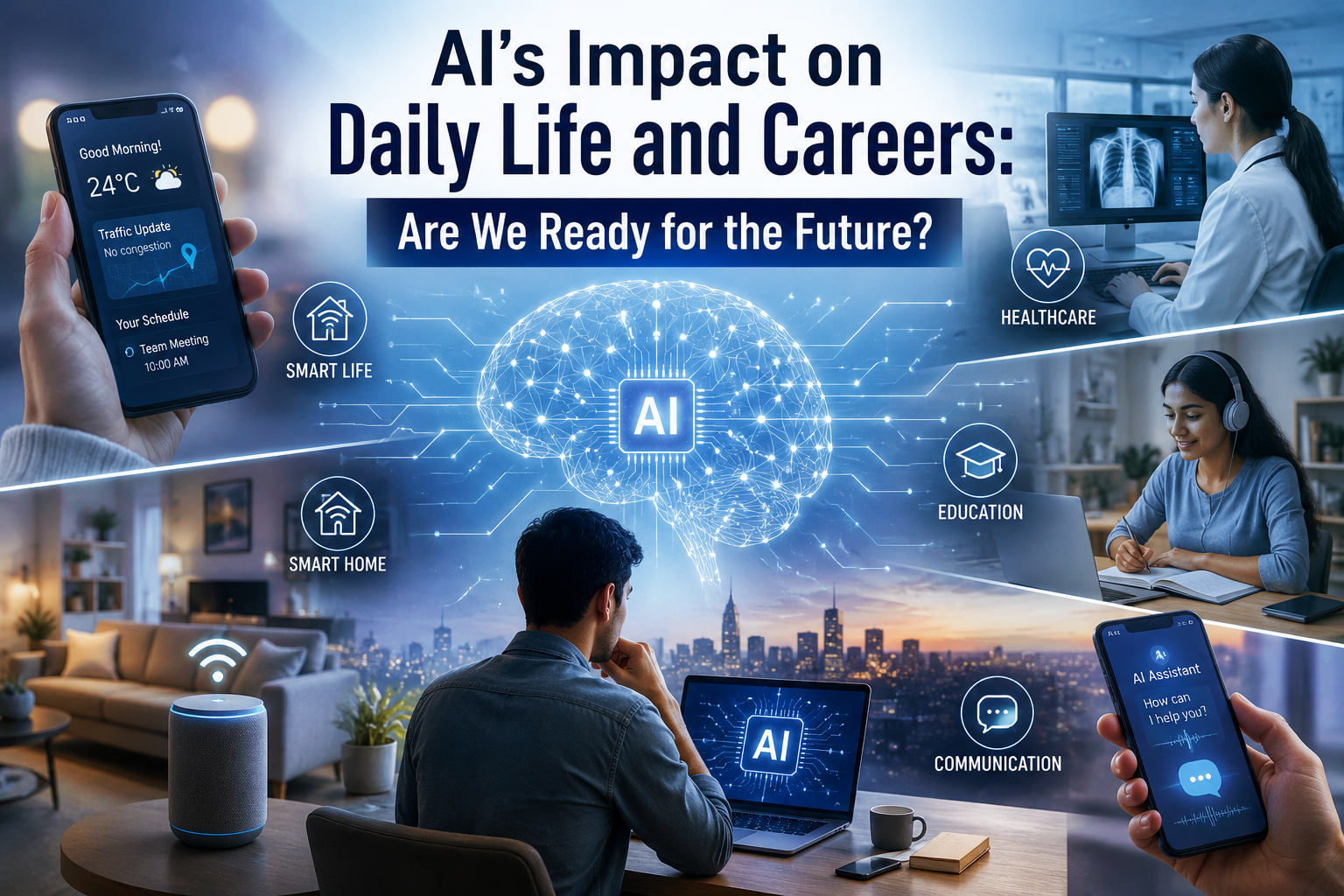
It is completely justified if we say that in 2026 AI has become as important as food in our daily life. The moment we open our eyes we need assistance from AI to check weather, traffic on the road, update on our previous day's work and to plan the complete day.
From the recommendations on which movie and show to binge watch to use auto-complete to finish a work email. It is completely influencing how we communicate, learn, shop, work and make decisions. It has become a pocket friend which codes our personal and professional life in the background.
Since AI is already having a great impact on our lives the real question is how we’ll adapt it in our future.
AI Created an Impact on our daily life and we barely noticed
AI didn’t enter our lives in the form of big gadgets like computers or AC, instead it entered into our daily gadgets and machines, and humanized them. From our mobile phones to our smart homes everything has human knowledge with enabled AI. It can understand human language, learn from our data, automate our daily tasks, help us in making decisions and what not.
Imagine a heavy day at work, and just like your mother your home is ready to welcome you, the AC has already cooled down your room, your Alexa is playing soft music and the lights have been arranged the way you want. Behind all these gadgets It’s AI which has learned about your mood and set up everything. The combination of Artificial Intelligence (AI) and the Internet of Things (IoT) is turning ordinary houses into smart homes.
The AI can perform tasks which were earlier limited to humans such as understanding language, recognizing images and speech, learning from data, making predictions, generating text, images, audio and video, solving problems, recommending content, automating repetitive tasks, supporting decision-making and this list never ending.
AI in Healthcare
AI has made a major difference in the healthcare sector. It helps healthcare professionals in analyzing medical images, identifying patterns, researching medicines, monitoring patients and reducing administrative workloads.
As per the reports of Stanford's 2025 AI Index in 2023 FDA approved 223 AI-enabled medical devices. This shows the growth of AI enabled medical technology.
However, AI can not completely replace doctors because human emotions and ethical responsibility are still human functions, AI can simply assist doctors by providing vital medical knowledge and in making appropriate decisions.
AI also helps humans in general in understanding their health activities, analyzing health issues and assisting in resolving them. Devices like wrist watches and smart rings track heart rate variability, skin temperature, and oxygen saturation. They provide signs of illness, recommend solutions in the form of exercises, doctor suggestions and much more.
These gadgets with help of AI also assist in daily activities to maintain health such as to note down daily steps, making you remember to drink water, analyzing sleep cycle, etc.
AI has changed traditional healthcare to become more effective and efficient.
AI in education
Education is another area where high impact of AI is observed.
Students are using AI in personal learning apart from textbook learnings. They can practice questions, simplify complex concepts, get assistance in project works and learn with more conviction. This helps students to learn at their own pace.
Ai not only supports students but educators as well. It helps them in enhancing their teaching methodology. AI helps them to devote their time in mentoring and interacting with students instead of creating basic lesson plans for students.
According to a 2026 Microsoft report, 92% of students and 88% of educators are already using AI for education related purposes.
As AI is empowering education, it also creates some challenges. AI is weakening the power of students to be creative and think independently. They are dependent on AI for their project work and assignments, instead of taking help they are duplicating it which creates the challenge of plagiarism, copyright etc.
The goal of AI in education should not be to create students who depend on machines for answers, but learners who know how to use machines while still thinking for themselves.
Communication
AI has created a huge impact on communication. It can be used for writing mails, creating social media posts, generating presentations, correct grammar and to add up to this AI can now learn and talk with you in your personal language so it is also used to enhance personal messages.
Knowingly or unknowingly we all are using AI features to make our communication smarter and faster. Imagine typing a document without autocorrect, predictive text, voice assistance, email spam filters, translation tools, or chatbots and other features of AI. It's kind of scary now. Traditionally all these activities were done manually and now it’s done in a single click.
For instance, you ordered some product and on not receiving its delivery you called the helpline number and the call was picked by an AI assistant instead of a human. This AI communication is so advanced that at least for 4-5 minutes you will not recognize that you are not speaking with humans. It will guide by checking the history of your order, it will check its supply chain, giving you its current status and will inform you of the further process.
AI has taken power in both written and verbal communication and that too at the humanize level. With all these advantages there comes a challenge as well as we are over depending on AI and lost personal touch in our communications. AI can also create gaps and miscommunication among communicators.
Using AI for enhancing communication is good but understand when you are highly dependent on it you are losing your human voice.
Navigation, Shopping and Entertainment is also impacted
AI is working behind our screens when we are moving from one place to another, listening to music, watching movies and shopping online. IT regulates our each and every activity on the internet.
It saves our data, analyzes it and on the basis of it we get movie recommendations, advertisements for the products we have been looking for on our social media and predicts our next shoppers stop.
According to Stanford's 2025 AI Index Waymo was providing more than 150,000 autonomous rides per week illustrating the movement of autonomous driving from experimentation toward real-world services. AI contributes to Traffic prediction, Navigation, Route optimization, Driver-assistance systems etc. it has made movement of humans from one place to another hustle free, but at the same time privacy has been lost in the hands of companies in the form of data.
So, navigating and scrolling online should be done wisely to not fall in any kind of cyber traps.
The Office evolution: AI’s impact on careers
AI has more significantly impacted on our workplaces, eventually impacting on careers. According to data from Stanford’s AI Index and McKinsey shows that 88% of organizations now use AI in at least one business function, and 58% of employees globally use it regularly at work. This data shows dependency of employees and organizations on AI and also creates the fear of unemployment
But is it really true? Will AI completely take over jobs?
The future of careers is more complicated than simply losing jobs to AI.
AI is used to simplify tasks involved in jobs. Some jobs may actually lose their value to AI while others may become extremely important.
For example, a marketing professional may use AI to generate several campaign ideas, but human creativity and judgment are still needed to decide which campaign fits the brand and its audience.
The horizon of job requirements may change but it cannot be completely vanished.
According to the World Economic Forum's Future of Jobs Report 2025, Nearly 40% of job skills are expected to change, therefore changing the requirements of employers, they now want employees who can learn and adapt to the AI environment.
The AI is more likely to take over generic tasks. For example, previously when you use to enter any organization there used to be a person who registers your details physically and then lets you enter the organization but now there are sensor gates which first scan you, note down your information, check with the authorities and then let you inside. This all work is done by AI so humans are needed to design it and to work with it.
Basically, organizations are shifting human roles upwards. Workplaces are demanding collaboration between humans and AI rather than simply replacing humans with machines.
Dark side of AI
Depending on AI with blind faith is not a clever job. As AI can not be 100% accurate. It can create incorrect information, can be used for creating fake content and can generate misinformation.
If AI is used in every communication, solving every problem, creating every image and make every decision, then humans may lose the battle.
AI should be used to increase our capabilities and to develop human skills so that AI cannot replace humans.
Bridging the Gap: Are we ready for the Future?
By observing the gap between the impact and dark side of AI it can be wisely said that we are partially ready for the future.
We are ready technically to integrate AI comfortably in our daily lives and careers but when it comes to accept it psychologically, and educationally, which can be different from human to human we are still lacking behind. We need to be responsible while using AI.
Being future-ready does not mean that everyone needs to do coding or learn complex technical skills, but it means to stay human in an AI world. We need to protect our digital lives, develop skills that machines cannot easily replace—such as innovation, creativity, empathy, strategical and critical thinking, and communication—and understand how to use AI without allowing it to take away our uniqueness, our emotions and our human connection.
Conclusion
Artificial intelligence is impacting daily life and careers at lightning speed. It is helping us in healthcare, education, communication and creating smart homes and lives, and at the same time the dark side of AI is creating challenges around privacy, employment and overdependency on technology.
The future of AI is not competition between machines and humans, but a responsible collaboration to ease work and increase productivity to be more effective and efficient in our daily lives and work opportunities.
The future belongs to those who combine machine intelligence with human strengths.