

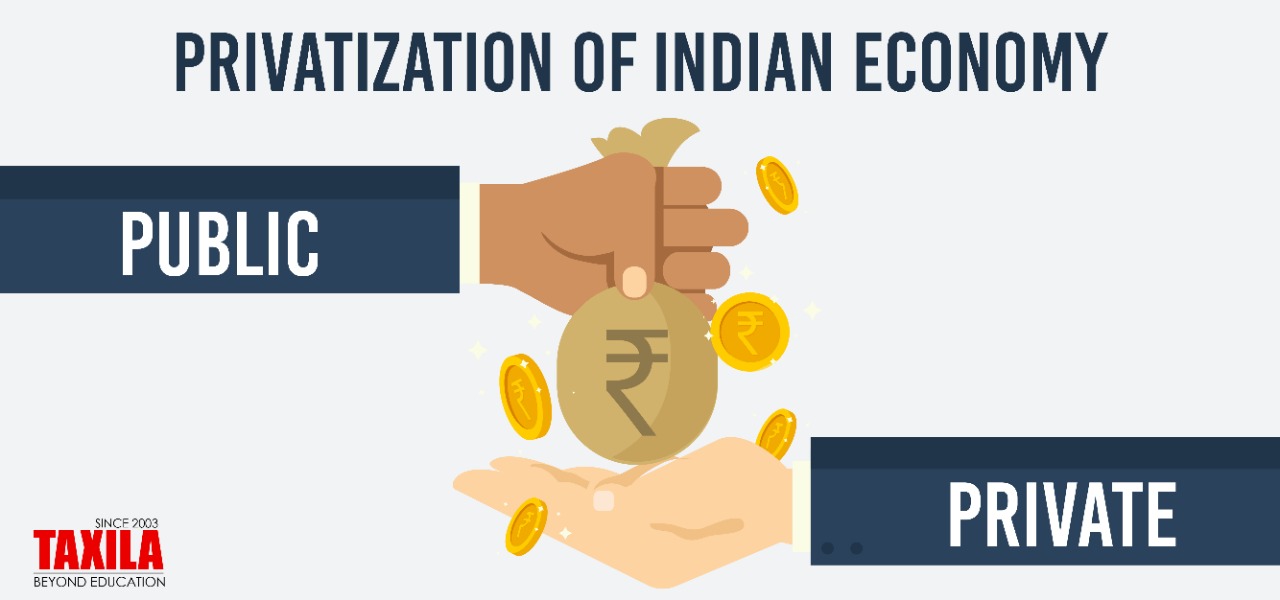
Impact of Privatization on the Indian Economy
The Central Public Sector Undertakings (CPSUs), since 1951, have had a vital part in the development of India’s economy. They were established to achieve higher economic growth and self-sufficiency. In 1951, there were only 5 CPSUs with ₹29 crores of investment, which was later taken to 348 with an investment of about ₹16.4 trillion in 2018-19. They started incurring losses and are now a fiscal burden of about 0.16% to our gross domestic product (GDP). The government decided to change its stance and stepped for disinvestment in 1991 through the new industrial policy. Since then, disinvestment policies have evolved over time, and the impact of privatization on the Indian economy is growing.
Privatization is making a huge impact on the Indian economy. During COVID, the Government’s revenue shrank drastically, and privatization turned out to be the central strategy for the recovery of the economy. But on the other hand, too much privatization may create a monopoly of some big players in the market.
Privatization and Corruption Relation
In India, government offices are an alternative expression to corrupt systems and officials. At the same time, we have seen the private sector grow leaps and bounds all the years. This leads to a belief that privatization can reduce corruption to a large extent.
On the other hand, private sector employees are often well paid, to leads to a motivated workforce, and that’s the reason they don’t want the bribe. Private companies take strict and necessary measures against bribes and other illegal offenses immediately. The competitive spirit of the private sector enterprises also gives a boost to GDP, which increases through taxes paid by these private organizations.

However, both the Private and Public sectors have been involved in corruption. Satyam Scam, 2G Scam, Commonwealth Games Scam, Telgi, Bofors Scam, Harshad Mehta Scandal, etc., are just a few examples to understand that corruption is about people who run the offices and not about the sectors. The biggest of the scams have often been carried out through the involvement of both the Private and Public sectors together. It has often been witnessed that private companies bribe government officials heftily to crack big business deals.
Ultimately, privatization is no guarantee of less corruption, as it has been a part of the private sector too. In fact, where the corruption levels are high in government, there is a higher degree of market concentration, and the prices also go up.
The magnitude of divestment and the nature of assets being privatized sometimes make things more vulnerable to corruption. Privatization can also be instrumentalized for personal or political gains. It is only good if the state obtains a fair value for the state assets for its taxpayers. A few sectors, like oil and gas, energy, mining, transportation, etc., are more susceptible to corruption and illegal practices because these are high-value procurement projects. So, it is important to get the privatization right, without indulging in irregular practices, because a failed privatization drive may have far-reaching consequences.
Finally, privatization may reduce corruption, but it cannot be the best solution to eradicate this vice. There are two sides to this thought. While some researchers establish that privatization lessens corruption, others believe that it can also induce corruption. With the optimized use of Privatization, we can reduce corruption and its further spread in India.
Read More: Why is an MBA Important?
Taxila Business School
- Highest Placement Rs 28.60 Lakh / PA
- Average Placement Rs 11.5 Lakh / PA
- SpecializationTriple Specialization with Business Analytics compulsory.
- Ranking 10th All India.
- RatingAAA+
Pros of the Privatization of the Indian Economy
- Economically, privatization at the micro-level tends to increase efficiency, quality, range of choices, innovation, reduce cost & prices, and ultimately raises the profits of the firm. These can be further downloaded into high incentives, lesser political interference, healthy competition, and reinvestment.
- At macro-levels, privatization helps generate cash from asset sales, which can increase capitalization. It improves government fiscal health, generates more wealth, and leads to overall economic growth. Wasteful spending, borrowings are checked, resulting in attracting foreign investments and new revenues that arise from new corporate and income taxes.
- At a social level, privatization reduces corruption in the public sector and red-tapism.
- The organizations in the private sector are more sensitive to consumer tastes and hence have enhanced customer service.
- Since there is ownership of shares, it empowers citizens’ participation in the management of the economy.
- Citizens experience greater personal freedom because of a reduction in state involvement.
Cons of Privatisation
- The critiques have an argument that privatization may create local monopolies. Monopolies, if created in utilities, will exploit their market power to the detriment of consumers’ welfare. They can reduce output and increase prices for profits.
- There are some examples from developing countries where divested assets were acquired by foreigners, who diverted the majority of their profits outside the country. So, there may be scenarios where there are no real benefits to the economy.
- Some experts also believe that privatization induces social inequality. Wealth may get concentrated in the hands of a few, generating unemployment and massive retrenchments. This might worsen the plight of the poor.
- Detractors also cite privatization as political opportunism, which can further be used for clientele politics. So there can be transformation but no elimination of corruption.
Read More: The Art of Management
Conclusion
Privatization can be the means to one thing, but may trigger multiple other impacts. There is no guarantee that privatization in India will reduce corruption and operate successfully in favor of Indian citizens. Corruption is not correlated to being in the private or public sector; it is about the individual’s attitude. But by privatization, we can reduce corruption to some extent. Privatization of the Indian economy will impact us in both ways, positively and negatively. We need to find a way to implement it in the best way.
It has both quantifiable and non-quantifiable long-term consequences. Privatization may be successful or can fail as well, depending on many attributable factors. Talking about India, there is so much political interference in the economy and its policy. Privatization steers the companies in the right direction, increasing good competition in the market. If driven right, privatization pushes efficiency and performance.
Popular Articles