

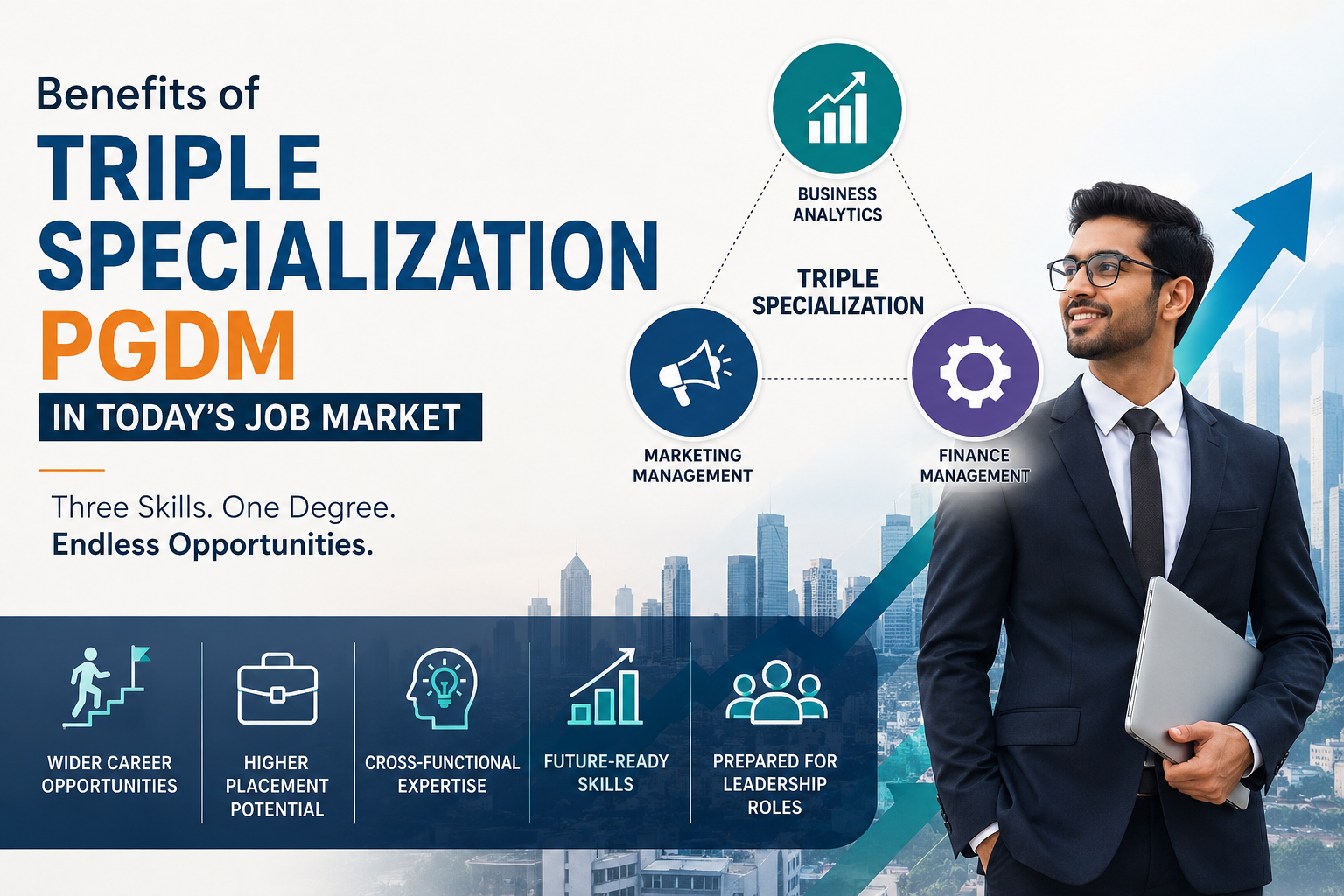
The modern business environment has evolved business leadership requirements. Earlier pursuing PGDM/MBA meant choosing one area of available specializations and getting expertise into it to build a successful career.
But now industries are working in a cross-functional environment. A finance person needs to have knowledge of AI tools and analytics. A marketing manager needs to understand the digital behavior of customers. HR needs to be professional in handling employee behavior. An operation manager must have perfection in handling supply chains and digital systems.
In today’s workspace there are no boundaries between business functions.
This is where a triple specialization comes into picture.
Instead of being an expert in one business area, triple specialization gives an opportunity to students to master three different domains at the same time. This is exactly like investing your money into multiple investments to diversify your income sources.
Employers value employees with knowledge and practical exposure to different business areas. It saves them from investing time and money in training such employees.
If you are a PGDM/ MBA aspirant, understanding how triple specialization works will help you make more informed decisions.
What is Triple specialization PGDM?
Post graduate programs in Management have evolved over time. One of the evolved formats allows students to develop expertise in three areas of business.
Instead of limiting a student's learning to one functional domain, the program exposes them to multiple disciplines and helps them understand how different parts of an organization work together.
Triple specialization helps students to adapt T- shaped leadership, high market agility and resilience.
Why single specialization doesn’t fit modern market requirements?
Professionals with single domain profiles are facing high career risks. Because employers look for employees who can resolve interdisciplinary problems. With changing technology and AI automation it is very difficult to survive with single domain expertise. A professional with pure finance background is struggling today to evaluate an IT infrastructure investment similarly an HR professional cannot use people-analytics software to predict workforce attrition, and business may face slowdown in process.
Triple specialization helps in eliminating this functional limitation before a student actually enters the workplace.
Read Also: Top PGDM & MBA Specializations: Career & Scope
Benefits of Triple specialization PGDM
Business problems are not limited to one domain. Managers need to have a bigger picture of business problems with cross functional knowledge. They need to understand business, data, technology and people together.
1. Development of T-shaped leadership: Corporates are seeking employees with T-shaped leadership quality. The vertical bar of T represents major specialization while the horizontal bar represents minor specializations symbolizing extended literacy in having cross functional knowledge.
The broader discipline knowledge is useful while working on business cases, consulting projects, entrepreneurship or managerial assignments where you have more than one correct answer.
2. Widens the career possibilities with increased placement opportunities: Placements on campus happen on the basis of specialization chosen by students. With triple specialization they are not restricted to apply for only one domain. They can target three domains which is an important benefit in career flexibility. Students can choose their career path based on their skills, interests and job offers. The real advantage is that students can build a broader skill portfolio and identify the functions in which they perform best. Since the job market is uncertain, flexibility achieved with triple specialization will be valuable.
3. Combination of Management and Technology: The work procedures have been completely changed by AI and automation because of which technology has evolved as business skill from IT skill. According to GMAC's Corporate Recruiters Survey 2025 employers increasingly value knowledge of AI tools among business-school graduates, along with problem-solving and strategic thinking continue to be highly valued. Triple specialization gives an opportunity to management students to add technical expertise to their core domains.
4. High Placement Packages: Cross functional managers eliminate the requirement of different employees for interrelated work in companies which allows organizations to value them more and provide high compensation in comparison to people with single domain knowledge. Their salaries are comparatively 15% - 30% are higher as per the data from campus recruitment across leading management institutions.
5. Prepare students for C-Suite leadership: Management education has an ultimate aim of creating future leaders who make decisions for organizations. To run an organization a professional needs to have leadership qualities of all domains whether its’ finance, operations, HR, marketing, analytics, and operations all at the same time they cannot completely rely on others if they need to make decisions. Understanding multiple functions can therefore help students develop a more holistic management perspective.
Read More: The Importance of Industry Exposure in Management Education
High demanded specialization combinations in today’s job market
1. Marketing + Business Analytics + Digital Marketing: Brand building and positioning is the most essential requirement of business. The combination of digital marketing and analytics bridges the gap of creativity and quantitative analysis of marketing. Modern businesses use data to retain customers, for which they require professionals with key skills of understanding consumer psychology, SQL, predictive analytics, performance marketing, search engine optimization (SEO), and campaign measurement. This combination opens the career paths to be Growth Marketer, Digital Product Manager, Performance Marketing Specialist, E-Commerce Operations Lead.
2. Finance + Business Analytics + Consulting: Students who are interested in solving numbers, data and making business decisions should go for this combination. Finance is one of the most important domains of any business and having an expertise in finance along with analyzing financial data opens up the opportunities in areas such as financial consulting, investment analysis, risk management, strategy management and financial planning.
3. Operations + Business Analytics + HR: Every organization deals with a lot of operations and humans; this combination focuses on both. Modern businesses have complex supply chains which require lean operational execution and talent management whether, hiring talent or retaining it, requires an expert skill with knowledge of AI tools and people analysis. This combination opens career pathways to be Supply Chain Operations Manager, HR analytics, Logistics Strategist, Talent Operations executive.
Single v/s, dual v/s, triple specialization
|
Criteria |
Single Specialization |
Dual Specialization |
Triple Specialization |
|
Focus |
One area |
Two areas |
Three areas |
|
Skill Set |
Specialized |
Diverse |
Multidisciplinary |
|
Career Options |
Limited |
Wider |
Widest |
|
Flexibility |
Moderate |
High |
Very High |
|
Business Understanding |
Functional |
Cross-functional |
Holistic |
|
Career Switching |
More difficult |
Easier |
More flexible |
|
Job Market Adaptability |
Moderate |
High |
Very High |
Read Also: Online Education: Pros and Cons | Finance Your MBA When You Don’t Have Money?
Recruiters Perspective: Why employers prefer employees with multi specializations?
Talent acquisition teams have the responsibility to hire highly skilled professionals who require minimal training. They look for T-shapes professionals who have in-depth understanding of one area along with knowledge across multiple areas, this allows them to have expertise in their core domain and along with that they are also able to communicate with people from other departments. Hence, they can be onboarded quickly without or with minimal cross-departmental training.
One of a senior hiring director at a global consulting firm quoted that:
"When we hire a graduate for our management consulting practice, we rarely give them pure marketing or pure finance problems. They encounter complex operational challenges that cross data analytics, cost accounting, and customer strategy simultaneously. Candidates with formal triple-specialization backgrounds adapt faster because they already understand how these functions interact."
Students having PGDM with triple specializations shows recruiters that they have high academic capabilities, business management literacy, and fulfills immediate onboarding requirements.
Conclusion: Three specialization for future-proofing career path
The biggest benefit of having triple specialization PGDM is cross functional management and not just ATS friendly resume.
It is a strategic investment in long term career building with multi-disciplinary knowledge for standing out in a dynamic business environment.
Students should not just focus on which specialization to choose but on what combination of skills are required to manage our future business problems? According to the research findings of WEF, NACE and GMAC employers are looking for professionals who have technical, analytical and human capabilities.
A well-designed triple specialization will help in becoming that professional. At Taxila Business School, the PGDM in triple specialization combines multiple areas of management education with Business Analytics and AI-oriented learning as compulsory specialization, helps students understand not only traditional business functions but also equips them with technology and data influencing modern decision-making. It prepares students not just for the first job but to be a professional who understands different things and works together for valued business results.
Read More:
- Top 10 Indian-Origin CEOs in the World 2026
- Impact of Privatization on Indian Economy 2026
- Top 50 Business Schools in India placement wise 2026
FAQs: PGDM with Triple Specialization
1. What is a Triple Specialization PGDM?
Ans. A Triple Specialization PGDM allows students to gain expertise in three different management areas.
2. What are the benefits of Triple Specialization PGDM?
Ans. It provides broader skills, career flexibility, and knowledge across multiple business domains.
3. Is Triple Specialization PGDM good for career growth?
Ans. Yes, it can help students explore diverse roles and adapt to changing industry requirements.
4. Which specializations can be combined in a PGDM?
Ans. Combinations may include Marketing, Finance, HR, Business Analytics, Operations, and related areas.
5. Does Triple Specialization improve job opportunities?
Ans. It can expand the range of roles and industries a student can consider.
6. Who should choose Triple Specialization PGDM?
Ans. It is suitable for students who want multidisciplinary management knowledge and career flexibility.
7. Is Triple Specialization better than single specialization?
Ans. Both have different benefits. Triple specialization offers broader exposure, while single specialization provides deeper focus.
8. What career options are available after Triple Specialization PGDM?
Ans. Graduates can explore roles in marketing, finance, HR, analytics, operations, and business development.