

Imagine studying marketing for two years and memorizing every framework, strategy and consumer-behaviour model. Then you are asked to launch a product in a real market where customers don't behave exactly like your textbook examples, competitors change their prices overnight and your campaign isn't generating the expected response.
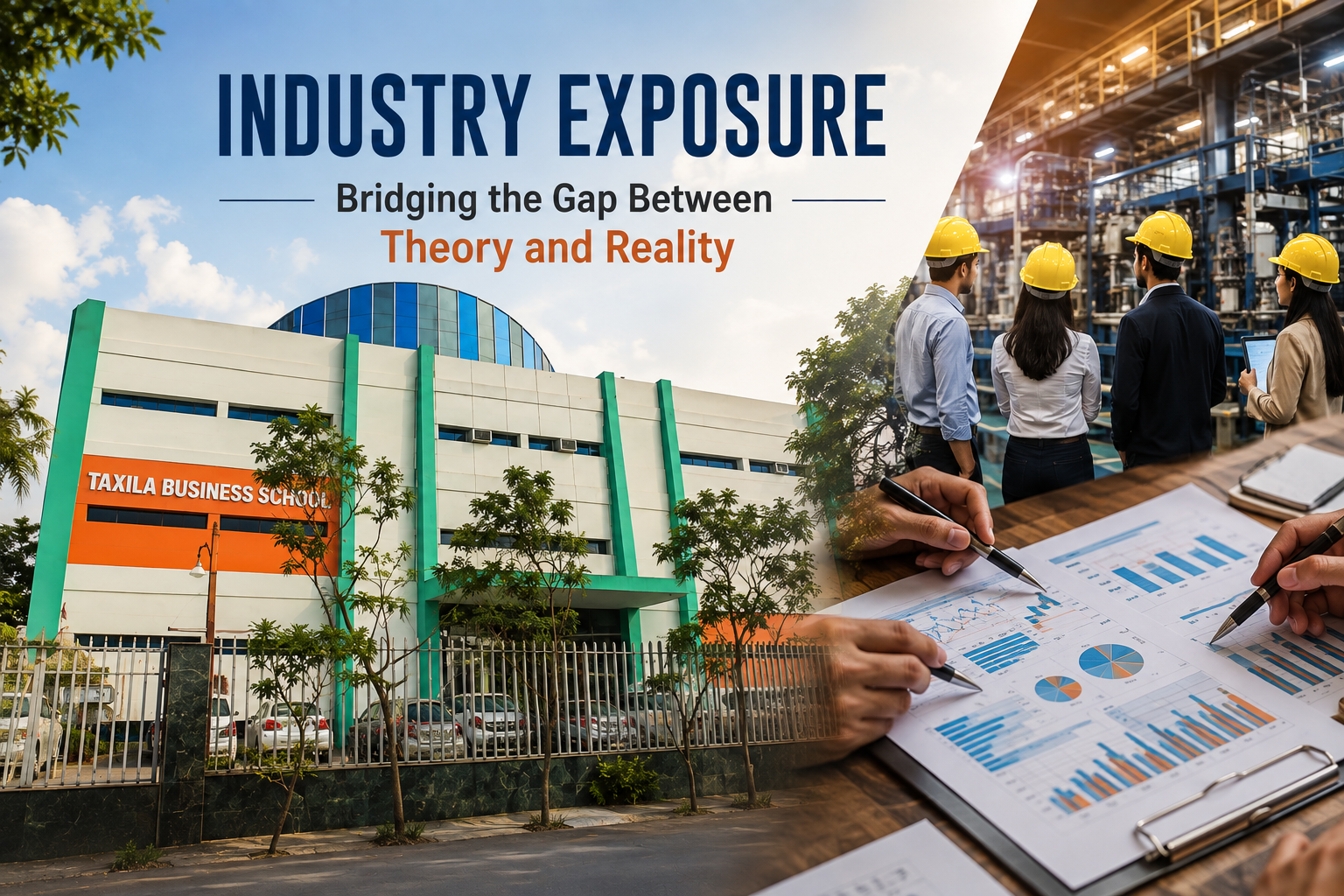
This is where industry exposure plays a vital role. Even having in depth knowledge of the process will not provide that expertise which will come from practical experience of situations. Industry exposure provides hands-on practical engagement of the concepts learned in the classroom.
In today’s fast evolving business environment textbook knowledge alone will not make you a master of industry. To deal with today’s employment landscape there is a need for industry oriented practical learning. Only 42.6% of Indian graduates applying for jobs are assessed as overall employable, down from 44.3% in 2023, as per the reports of Mercer | Mettl's India Graduate Skill Index 2025
This highlights how important industry exposure is in the education system. Academic qualifications need to be supported by practical skills that students can apply in the workplace.
Read Also: Top 10 Indian-Origin CEOs in the World | Top 50 Business Schools in India placement wise 2026
Limitations of Sole Academic learning
While academic learnings are important to understand the scenarios, real case studies are a tool kit to solve those scenarios.
- The Skill Gap: Only gaining textbook knowledge creates a vast skill gap which can only be bridged by equipping students with real world scenarios. Technology and corporate strategies are dynamic in nature, it is almost impossible to introduce all these changes in academics right on time. Hence a skill gap is created between the concepts learned and applied.
- Uncertainty in working with stakeholders: Dealing with stakeholders needs emotional intelligence more than academic knowledge. Vendor negotiations, dealing corporate conflicts and giving presentations are learned through practical experience. It can not be memorized from any text book.
- Corporate readiness: Now a days no employer wants to invest a lot of time in corporate training for freshers, they want professionals who already understand workflows,corporate etiquette,and performance metrics from the beginning, and that is only possible if the fresher has gained some hands-on industry experience during their academics.
What Is Industry Exposure in Management Education?
Industry exposure refers to the real-world execution of management theories learned in classrooms, or the opportunities provided to students to experience and understand the real business environment during their academic journey.
These practical learnings can be in the form of internships, case-studies, simulations, live business projects, workshops, guest lectures by industry professionals and interactions with corporate leaders.
The objective is to help students in smooth merging of the concepts they have learned into actual organizations. Theoretical and practical exposure together creates an effective management education.
Read This: Top MBA Colleges Accepting CMAT Score in India | Top MBA Colleges in India Without CAT Exam 2026: Ranking, Placements, and Fees
Importance of Industry Exposure Management Students
- Reduces the gap between theoretical and practical knowledge:
The gap between theory concepts and their application can only be reduced by practical exposure in the education system.
For instance, a case study describes organizational problems. A live project could help students to analyze it and recommend solutions.
The later experience will give them the confidence to be a strong professional. It will help them to not simply know something but to apply them practically.
- Employee valued skills:
The new age employers value skills which are beyond textbook knowledge, they want employees who have soft skills along with hard skills, employees who can work in a dynamic environment.
According to The World Economic Forum's Future of Jobs Report 2025, 69% of employers consider analytical thinking the most important core skill, 67% of employers want resilience, flexibility and agility , while leadership and social influence stood at 61% in the valued skills by employers. These skills are built by practice and not by knowing.
- Strengthens corporate skills: Soft skills are the most important requirement in today’s AI driven workplaces. Students should be given opportunities to work on projects, interact with professionals, defend their recommendations, collaborate with peers and solve business cases, which can help them to develop and strengthen their skills.
- Makes student career ready: From being a student to starting as a fresher in corporates marks a huge transition as workplace expectations are different from academic expectations.
They have to transit from giving exams to meeting project deadlines, work accountability, reporting structures and meeting client and employer expectations. Industry exposure gives students an early understanding of these realities. - It Develops a Cross-Functional Business Perspective: Modern business works in a cross functional environment. Marketing decisions influence sales. Operations affect customer satisfaction.Finance influences investment decisions. Human resources influence organizational performance. Technology affects every domain.
It is very essential to understand these relationships and develop the cross-functional approach in students. Industry exposure meets this requirement of organizations.
Read Also: Impact of Privatization on Indian Economy: Advantages, Disadvantages & Examples
Types of Industry exposure
-
Internships: It is the most direct way of connecting students with the professional world. Every program must have at least two internships as a compulsion in its curriculum structure.
The scale of India's internship ecosystem also illustrates the growing emphasis on practical experience. In February 2025, the Government of India's Prime Minister Internship Scheme announced more than 1 lakh internship opportunities, with participation from 300+ companies across sectors and opportunities across 730+ districts. The first round had received more than 6 lakh applications.
Internships should not only be measured on the certificate received in the end but the exposure to workplace culture, professional communication, business processes, teamwork and decision-making. - Industrial Visits and Live Projects: It allows students to understand and observe the real problems and learn from the experience of others. This helps students not only to ask questions but to see the real-world solutions to their questions. That shift is one of the most valuable outcomes of industry-oriented management education.
- Experiential Learning: It connects knowledge with action. In this sort of learning when students apply some concept and find a business solution, they get the feedback from the experts which reflects and creates a learning cycle that complements traditional classroom education. In this both theoretical and practical learning works together, which is the real objective.
How Taxila Business School Prepares Industry-Ready Leaders
At Taxila Business School, industry exposure is part of the curriculum. Taxila is ranked among the top B-schools in North India, and it bridges the gap between academic learning and industry exposure through an applied learning approach:
- PGDM with Business Analytics Integration and triple specialization: Combining core management functions with deep business analytics as compulsory subjects to ensure students are ready as per today's rapidly changing business environment.
- Multiple Internships and Projects: Taxila provides more than 1 structured internships (Winter and Summer programs)—ensuring students get hands-on experience.
- Corporate Acceptance : Taxila focuses on practical application, students are consistently provided placements with global leaders like PwC, EY, Accenture, Deloitte, and S&P Global.
- Campus immersion and Industry Visits: Taxila focuses on industry visits from the very beginning. Students are made to visit multiple industries to get the real exposure so that they can learn from industry experts. Campus immersion to different institutes help them to learn from competitors and become corporate ready.
Taxila Business School
- Highest PlacementRs 38 Lakh / PA
- Average Placement Rs 11.50 Lakh / PA
- SpecializationTriple Specialization with Business Analytics compulsory.
- Ranking10th All India.
- RatingAAA+
Conclusion: Elevate Your Career with Industry-First Management Education
The importance of industry exposure in management education lies in one fundamental idea: management is a discipline that must ultimately be practiced.
The end goal is not to achieve a degree but to be industry ready for higher career success. The future belongs to a professional who has an academic degree and combines it with application of this knowledge and is a confident professional who is corporate ready.
Industry exposure is not an option but an important requirement of management education.
Read Also: New Education Policy India: Latest Updates | Top PGDM Specializations in 2026
FAQs
Q1. What is industry exposure in management education?
Ans. It is the real-world application of classroom theory through internships, live projects, case studies and guest lectures.
Q2. Why is industry exposure important for MBA and PGDM students?
Ans. It bridges the gap between theory and practice, builds soft skills, leader ship and makes students career-ready.
Q3. Is academic learning alone enough to get a job after an MBA?
Ans. No. Only 42.6% of Indian graduates are assessed as employable (Mercer | Mettl, 2025), so employers want practical, job-ready skills.
Q4. Which skills do employers value most today?
Ans. Analytical thinking (69%), resilience and agility (67%), and leadership (61%), per the WEF Future of Jobs Report 2025.
Q5. What are the main types of industry exposure in an MBA?
Ans. Internships, industrial visits, live projects and experiential learning.
Q6. How does Taxila Business School provide industry exposure?
Ans. Through PGDM with Business Analytics, internships, live projects, industry visits and campus immersion.
Q7. What are the placement highlights at Taxila Business School?
Ans. The highest package is Rs 38 LPA and the average is Rs 11.50 LPA, with recruiters like PwC, EY, Accenture and Deloitte.
Read More: