

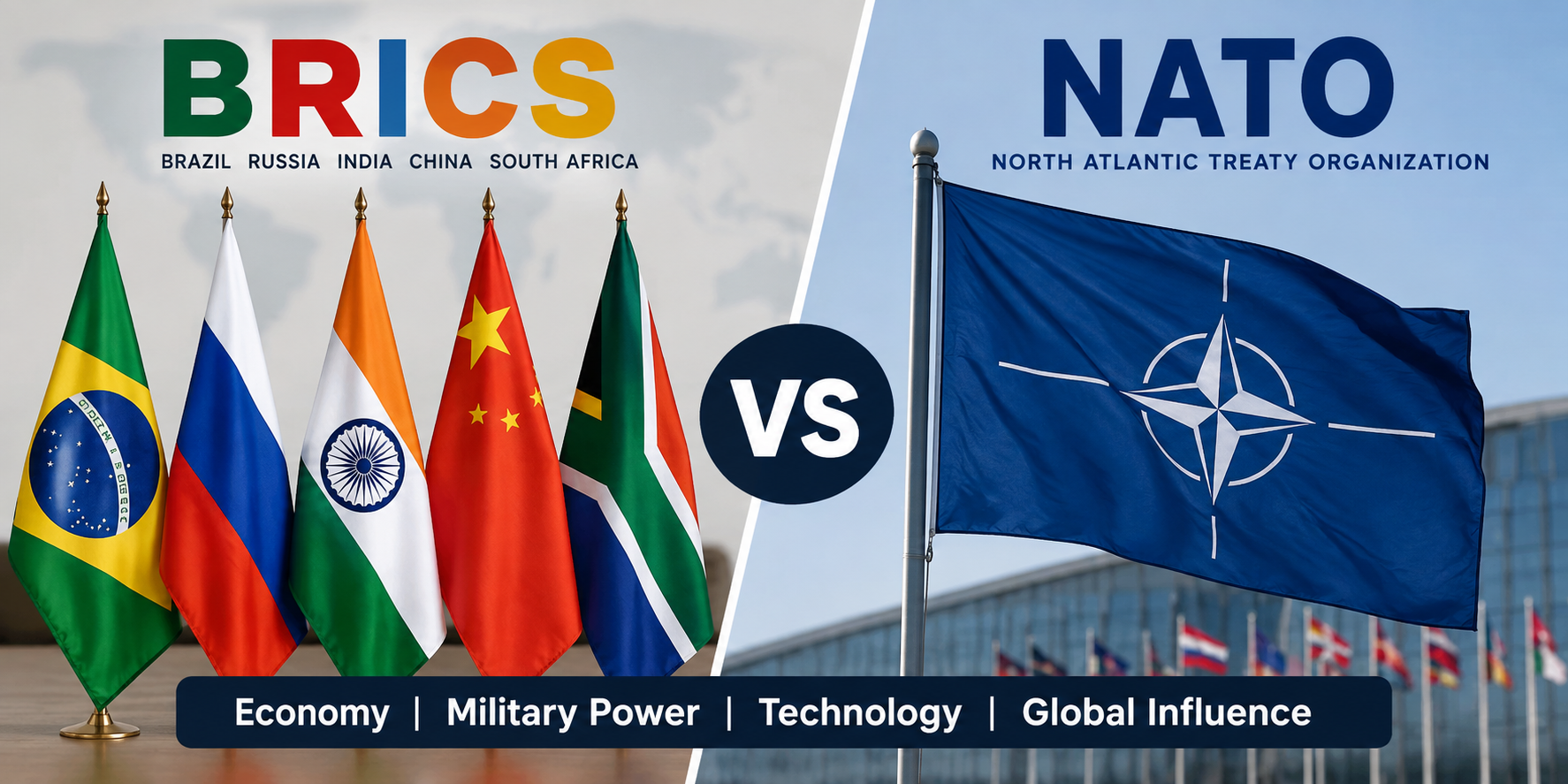
What is BRICS
BRICS is a group of major emerging economies that cooperate on economic, financial, and geopolitical issues. The name originally came from its first members:
- B — Brazil
- R — Russia
- I — India
- C — China
- S — South Africa
It began as BRIC (Brazil, Russia, India, China), with the first leaders' summit held in 2009. South Africa joined in 2010, creating BRICS.
What is NATO
NATO stands for North Atlantic Treaty Organization. It is a military and political alliance of countries mainly from Europe and North America.
NATO was established on 4 April 1949 after World War Second. Its main purpose is collective defense—meaning an attack against one NATO member can be treated as an attack against all.
NATO currently has 32 member countries, including:
| Country | Country | Country |
|---|---|---|
| United States | United Kingdom | France |
| Germany | Italy | Canada |
| Türkiye | Poland | Spain |
| Finland | Sweden | Norway |
There are dramatic shifts in the global balance of power at present.
The US and its NATO allies were dominant players in the international arena during most of the post-Cold War period. However, the emergence of powers like China and India has made the international system much more complicated than before.
In this regard, there are two contrasting entities involved: BRICS and NATO
BRICS constitutes an increasingly powerful coalition of major emerging economies, whereas NATO is a structured alliance aimed at collective defense. In the year 2026, analyzing both BRICS and NATO will be an engaging approach to assessing the balance of economic, military, and technological powers around the world.
However, the simple comparison of “Who is stronger?” is not quite relevant.
A better one would be “Where are the strengths of each group?”
See: Top 50 Business Schools in India | PhD After MBA: Entrance Exams, Fees, Salary & Career Options
BRICS Versus NATO At-a-Glance
There have been tremendous changes in BRICS, with countries belonging to BRICS ranging from economies to energy producers in Asia, Africa, Middle East, and Latin America.
In 2023, “Saudi Arabia was approached to become a member of BRICS, although as of 2026 its membership status was still undefined. Although the documents issued by BRICS identified Saudi Arabia as one of the extended membership members, Saudi Arabia never officially agreed on full membership.”
NATO on the other hand comprises 32 countries and is based on collective defense and military collaboration.
However, the basic distinction lies here, that while BRICS is a platform for economic and political cooperation, NATO on the other hand is an alliance for security and defense.
1. GDP - The Economic Dimension
Economic strength is arguably one of the key indicators of international power.
The BRICS group has many of the biggest emerging economies in the world, especially China and India, along with energy and raw material exporters such as Russia, Saudi Arabia, Brazil, Iran and UAE.
This provides BRICS with great economic strength in terms of:
- Population
- Natural resources
- Energy
- Manufacturing
- Agriculture
- Consumer markets
- World trade
Nonetheless, the measurement of the GDP can vary depending on the type of GDP that is being measured. In this case, there are two types: nominal GDP, which takes into consideration the market exchange rates, and PPP GDP, which considers domestic purchasing power.
Hence, the choice of measure can greatly influence the comparison of the BRICS and NATO countries.
Read About – PGDM vs MBA | Top MBA colleges in India accepting MAT score
2. Military Force - A Key Strength of NATO in Expenditure
- It is a military force which makes the comparison truly intriguing.
- SIPRI reveals that worldwide military expenditures amounted to $2.887 trillion in 2025, the highest SIPRI has recorded.
- The US spent approximately $954 billion, whereas China spent about $336 billion and Russia $190 billion. India spent approximately $92.1 billion and Saudi Arabia $83.2 billion.
- This is why the US plays such a vital role in the NATO comparison.
- The US military budget alone exceeded military expenditures of any other individual country in 2025.
NATO the advantages of:
- Strong air force
- Strong naval force
- Nuclear deterrence
- Satellite and intelligence systems
- Long-range attack capabilities
- Strong logistics
- Military planning
- Military interoperability
The strength of NATO's military capacity is derived not only from expenditure but also from integration.
3. Military Strength of BRICS
- BRICS is not to be considered as a normal military alliance.
- All its members have completely varied policies regarding defence.
- But a number of BRICS nations do have substantial military strength.
China ranks second in the world when it comes to military spending. China has built strong naval strength along with missiles, drones, space and cyber war capabilities.
Russia is one of the great nuclear and military powers in the world. Russia has ample experience in conducting large scale conventional warfare.
India is another nation that owns nuclear weapons, a large army, missiles and a defence industry.
Saudi Arabia spends heavily on its military, with some other members of the BRICS alliance spending significantly on their military too.
According to SIPRI, the second, third and fifth largest military spenders in the world for 2025 would be China, Russia and India respectively.
Thus, the BRICS nations possess a large amount of military power, though the BRICS alliance itself is not a military alliance like NATO.
4. Technology - The New Battlefield
- Military strength in 2026 will not be measured just by the number of soldiers, tanks, and airplanes.
- Technology plays an equally crucial role.
- AI, semiconductors, quantum computing, cyber abilities, satellites, drones, robotics, and autonomous weapons are reshaping modern warfare and competition between nations
- Technological advantages of NATO
- The member states of NATO include the US along with some of the most technologically developed nations on Earth.
The US has massive capacity in:
- Artificial intelligence
- Aerospace technology
- Chip design
- Cloud computing
- Cybersecurity
- Satellites
- Weapons
- Software
- Defense research
Aerospace, automobiles, electronics, telecommunication and military hardware are other industries where European NATO member nations excel.
Read Also: Top 10 Indian-Origin CEOs in the World 2026
Technological Prowess of BRICS
China has emerged as an important technological nation especially in:
- Manufacturing
- Telecommunication
- Electric cars
- Artificial Intelligence
- Drones
- Batteries
- Industrial automation
- Space technology
India’s areas of strength are:
- Software
- Information technology
- Digital infrastructure
- Space technology
- Pharmaceuticals
- Engineering
Russia remains capable in:
- Nuclear technology
- Missiles
- Aerospace
- Military
- In this way, the technology race is not just “BRICS vs NATO.”
- It should be seen rather as a technology ecosystem race.
5. Nuclear Power - Alters the Picture
- Both categories include nuclear weapon countries.
- In the case of BRICS countries, Russia, China, and India have nuclear weapons.
- In the case of NATO countries, the United States, the United Kingdom, and France have nuclear weapons.
- Thus, making a simple military ranking is quite impossible.
- Nuclear weapons make an entirely new picture since even conventional military advantage does not ensure the impossibility of devastating retaliation.
- So, nuclear deterrence is one of the areas where just analyzing military expenditure is not enough.
Read Also: Blended MBA in India 2026: The Future of MBA education
6. Population and Natural Resources
- It is one of the areas where BRICS holds significant structural strengths.
- BRICS consists of the countries that have large populations and are major suppliers of energy, gas, minerals, and agriculture products.
- Together China and India constitute a huge part of the world’s population.
- Other members of the BRICS group include major energy producing nations like Russia, Saudi Arabia, Iran, and UAE.
- This makes BRICS very important for any discussion on:
- Energy + Food + Minerals + Manufacturing + Consumer markets
On the other hand, NATO consists of a relatively small population but comprises countries which are among the richest and technologically advanced in the world.
7. The Most Significant Distinction Between BRICS and NATO
- It can be considered the most significant distinction between BRICS and NATO throughout the whole comparison.
- NATO is a collective-defence pact organization.
NATO countries have military infrastructure, command structure, joint training, and interoperability systems. The NATO 2026 common-funded military budget provides funding for the Alliance's command, training, exercises, and operations.
- However, BRICS does not include such a collective-defence system.
- All the BRICS countries have different political systems, economic models, and foreign policy goals.
- China and India, for instance, are the BRICS member states, but they have their own strategic confrontation and territorial conflicts.
- In other words, it would be wrong to think that all the BRICS members will become one military power automatically.
|
Criteria |
BRICS |
NATO |
|
Economic weight |
Very large emerging-market base |
Very large developed-market base |
|
Population |
Very high |
Lower |
|
Natural resources |
Significant |
Significant and more diversified |
|
Military spending |
Significant due to spending from China, Russia, India and others |
Extremely high due to collective spending |
|
Nuclear capability |
Russia, China, India |
US, UK and France |
|
Technology |
Strong Chinese, Indian and Russian technology |
US technology + European tech ecosystem |
|
Manufacturing |
High due to presence of China |
Advanced |
|
Military integration |
Limited |
Very well-developed |
|
Collective defence |
No collective defence as seen in NATO |
Purpose of NATO |
|
Financial power |
Rising |
Well established |
Read Also:
- Best Business Analytics Jobs in 2026
- Role of RBI in Indian Economy: Functions, Importance and Impact
- MBA in 2026: Business Analytics + other Specializations
- Top Tier 1 MBA College in India 2026 | Average & Highest Package, Fees & College
Who Is More Powerful Then?
- Well, there is not one straightforward answer, as there are many aspects to power.
- When considering military integration and defense, then NATO has highly sophisticated institutional advantages.
- When considering size of population, natural resources, and development of the several emerging economies, then BRICS has very powerful structural leverage.
- When considering technological advancement, then both groups have several major technological players, though they excel in different spheres.
- When considering military expenses, then total spending of NATO members is very large, especially due to US and European members. According to SIPRI, European members of NATO spent approximately $559 billion in 2025.
- When considering economic diversification, then BRICS symbolizes quite a considerable part of this process.
India’s Role in BRICS-NATO
- India is interesting because it is involved in relations with both sides.
- India is a BRICS country, but it is also a close partner of the US and many NATO countries due to broader strategic and defence cooperation.
- India’s military spending amounted to $92.1 billion in 2025, making India the world’s fifth biggest spender on military equipment according to SIPRI.
You can think about in-
- Defence industry
- Space program
- Nuclear capabilities
- Big armed forces
- IT industry
- Pharmaceutical industry
- Geopolitical importance for the Indo-Pacific region
- Relations with the US, Europe, Russia and BRICS countries
Conclusion: The World Is Evolving Toward Multipolarity
- The comparison of BRICS and NATO is not only an example of a competition of two sides.
- In fact, it is a part of a larger process that takes place within international relations.
- NATO still retains significant military, technological and financial potentials due to the role played by the US.
- On the other hand, BRICS has managed to unite an exceptional combination of the parameters mentioned above: population, power of emerging economies, energy, industry and strategic powers.
- Thus, instead of discussing whose victory will determine the future balance of the world, it seems better to consider whether some countries are capable of transforming their economic potentials into technological development, military power, financial power and partnerships with other countries.
- The main story of 2026 is not about the replacement of one global center of power by another.
Rather, it is the appearance of a more complicated multipolar international system characterized by the distribution of economic power, military potential, technology, energy and diplomacy among several centers of power.
See: Popular MBA Specializations in India 2026-27: Fees, Placement & Career Scope
FAQs: BRICS vs NATO
1. What is BRICS?
Ans. BRICS is a group focused mainly on economic, political, and development cooperation among member countries.
2. What is NATO?
Ans. NATO is a military alliance based on collective defence and security cooperation.
3. Is BRICS a military alliance like NATO?
Ans. No. BRICS is not a collective military defence alliance like NATO.
4. Which is more powerful, BRICS or NATO?
Ans. It depends on the area. NATO has stronger military integration, while BRICS has major strengths in population, resources, and emerging economies.
5. How many countries are in NATO?
Ans. NATO currently has 32 member countries.
6. Which has greater military power, BRICS or NATO?
Ans. NATO has an advantage in integrated military capabilities, technology, logistics, and collective defence.
7. Does BRICS have nuclear-armed countries?
Ans. Yes. BRICS includes nuclear-armed countries such as Russia, China, and India.
8. What is the main difference between BRICS and NATO?
Ans. BRICS mainly focuses on economic and political cooperation, while NATO focuses on collective security and defence.