

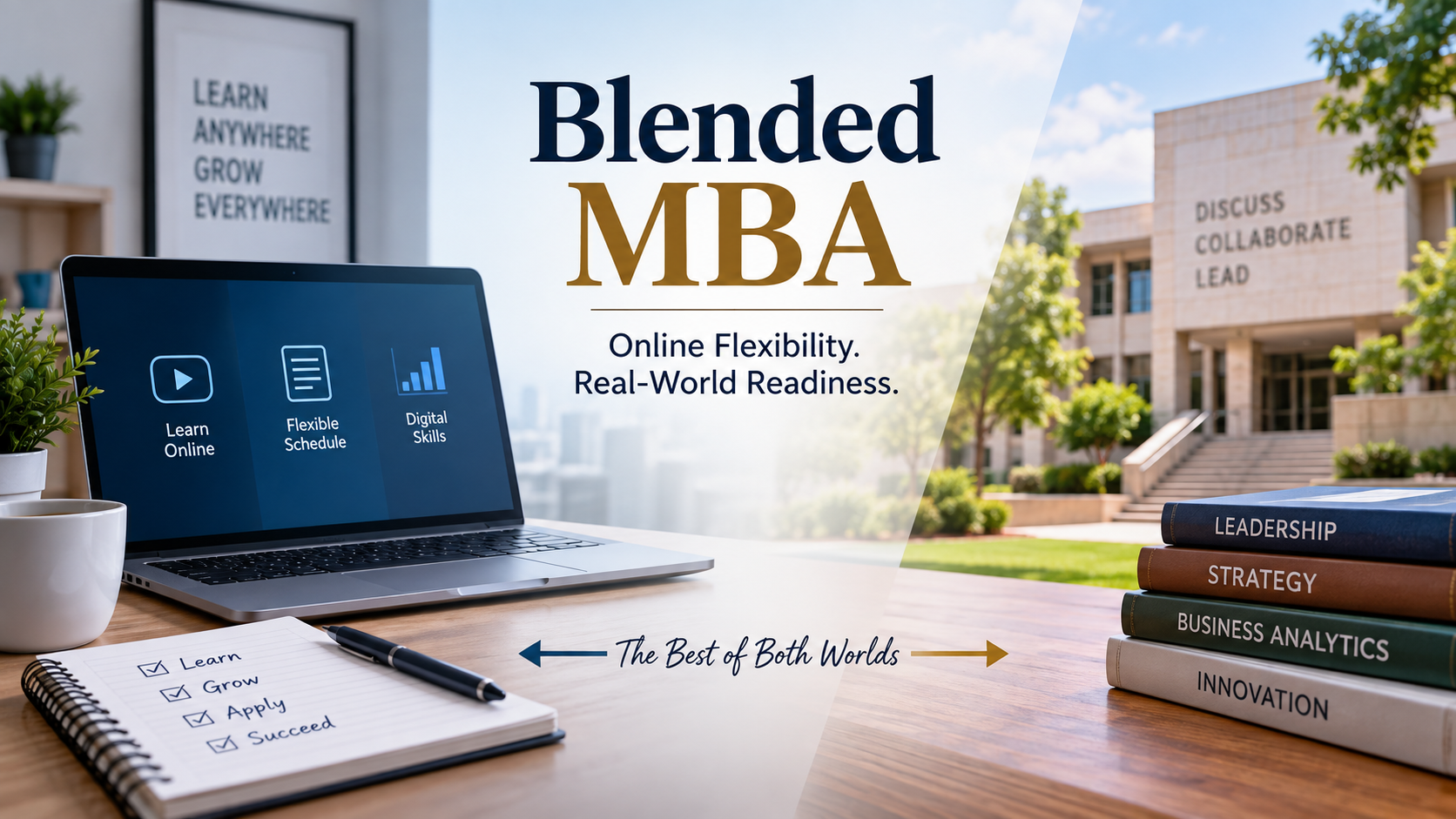
We have been hearing since ancient times that balance is the key to life. The same idea applies to education. With the rapid advancement of technology, the debate over online versus offline learning is growing stronger. But do we really need to choose between the two for our education? Instead, the best way is to bring both the modes together—and that is exactly what blended learning offers.
Over the years, MBA has been taught in the traditional format of on-campus learning and face- to- face classes. However, with advancement in technology online MBA programs have found their place in the education system. Today as both online and offline MBA has evolved, there is a need for blended learning that can address the limitations of both approaches, a perfect combination of campus exposure and digital learning tools, preparing future MBA professionals for both online and offline working environments.
Management education is not limited to textbooks. The purpose of management education is to create highly skilled professionals who possess soft skills, communication, leadership and team management skills. To develop these skills students need human interaction with practical exposure. Hence completely online MBA programs fail to provide these learnings. Blended learning combines the positives of online learning and offline interactions and with reduced limitations of both the approaches it creates the effective approach for MBA education.
Let us now take a deeper look into how blended learning overcomes the limitations of the online and offline education system, what challenges it still needs to overcome and why it is increasingly becoming the future of MBA education.
Why is MBA education changing?
In previous times, businesses used to operate within limited geographical boundaries, business operations were restricted to small areas. Today, in 2026, businesses operate globally in a data driven environment powered by high technology, algorithms and artificial intelligence.
To operate effectively in this technology-driven environment, organizations need modern managers who are highly skilled and capable of working with emerging technologies.
Traditional MBA programs focused on textbook knowledge of Finance, operations, marketing and human resources with limited scope and today all of these domains require knowledge of AI tools and data analysis to manage data-driven organizations.
MBA professionals therefore need to understand data analysis and AI tools, effective communication, solve cross-functional business problems, lead and manage teams, make decisions under uncertain busines environment, work with latest technology, and adapt quickly to changing business environments.
Students and professionals also need flexibility to manage their multiple tasks at same time. They may want to do jobs and internships to add experience along with their education. Blended learning gives them this format, where they can take their classroom lectures online and with campus immersions they can network and learn from peers and faculty members.
According to GMAC's 2025 data, consideration of hybrid MBA programs in Asia/Pacific increased from 5% in 2020 to 11% in 2024.
We can now understand that the future of MBA education is a balanced combination of online flexibility and offline engagement.
Top management institutes like IIM s have also launched their blended programs for working professionals with which they can manage jobs, studies and also get campus experience during immersion programs.
Read Also: Top 50 Business Schools in India placement wise 2026
Benefits of Blended MBA programs
1. Flexibility: The most important benefit of online and blended MBA programs is the flexibility of learning. Students can learn from any place from premium institutes they don’t need to be present at campus every single day. With the flexibility offered they can take up a job or internship while completing education simultaneously.
2. Digital Mastery: Online modules are provided with latest technology upgrades and AI-driven practice assessments, allowing students to master technical concepts at their own pace without compulsory offline classes. Blended MBA programs can incorporate technology directly into the learning process through Learning management systems, simulations, data analytics platforms, generative AI applications. This makes them ready for the working environment.
3. Experimental learning: This approach is considered the best form of learning becaFuse students can learn and apply the concept at the same time. Gone are the days when organizations used to hire people with the best memories, now they want professionals who can learn and adapt in a dynamic environment, who are self-driven and know how to learn and unlearn quickly. Blended approach provides a platform for experimental learning.
4. Campus immersions: The USP of blended MBA learning is that it is not completely online. This student visits campus several times which gives them the opportunity to network and learn soft skills that MBA professionals require. These campus immersions are highly impactful as candidates get to engage in intense negotiation simulations, leadership labs, presentations, and cross-cultural peer networking.
This approach of blended MBA combines digital learning with strategically planned campus experiences meeting the benefits of both online and offline MBA.
See: Top PGDM Specializations in 2026 | Role of RBI in Indian Economy
Offline vs Online vs Blended MBA
|
Criteria |
Offline MBA |
Online MBA |
Blended MBA |
|
Learning Mode |
Classroom-based |
Fully online |
Online + classroom |
|
Flexibility |
Low |
High |
High |
|
Face-to-Face Interaction |
High |
Limited |
Moderate to High |
|
Networking |
Strong campus networking |
Mostly virtual |
Campus + virtual networking |
|
Practical Exposure |
Classroom activities & projects |
Virtual projects |
Classroom + virtual activities |
|
Technology Integration |
Moderate |
High |
High |
|
Best For |
Students preferring campus life |
Working professionals & flexible learners |
Students seeking flexibility + campus experience |
Also read:- Top MBA Colleges in India | Best Business Analytics Jobs in 2026
Challenges and solution of Blended MBA education
Being a highly beneficial blended MBA still has some challenges and possible solutions to offer.
|
Conclusion:
Blended MBA doesn't ask students to choose between online or offline studies, it gives them both the options. With the changed business environments, education also needs reform and this approach of education builds professionals who can work in a data driven environment and make informed decisions for business with their skills and knowledge.
For modern business managers blended learning is the approach to build long term successful careers
Read More: