

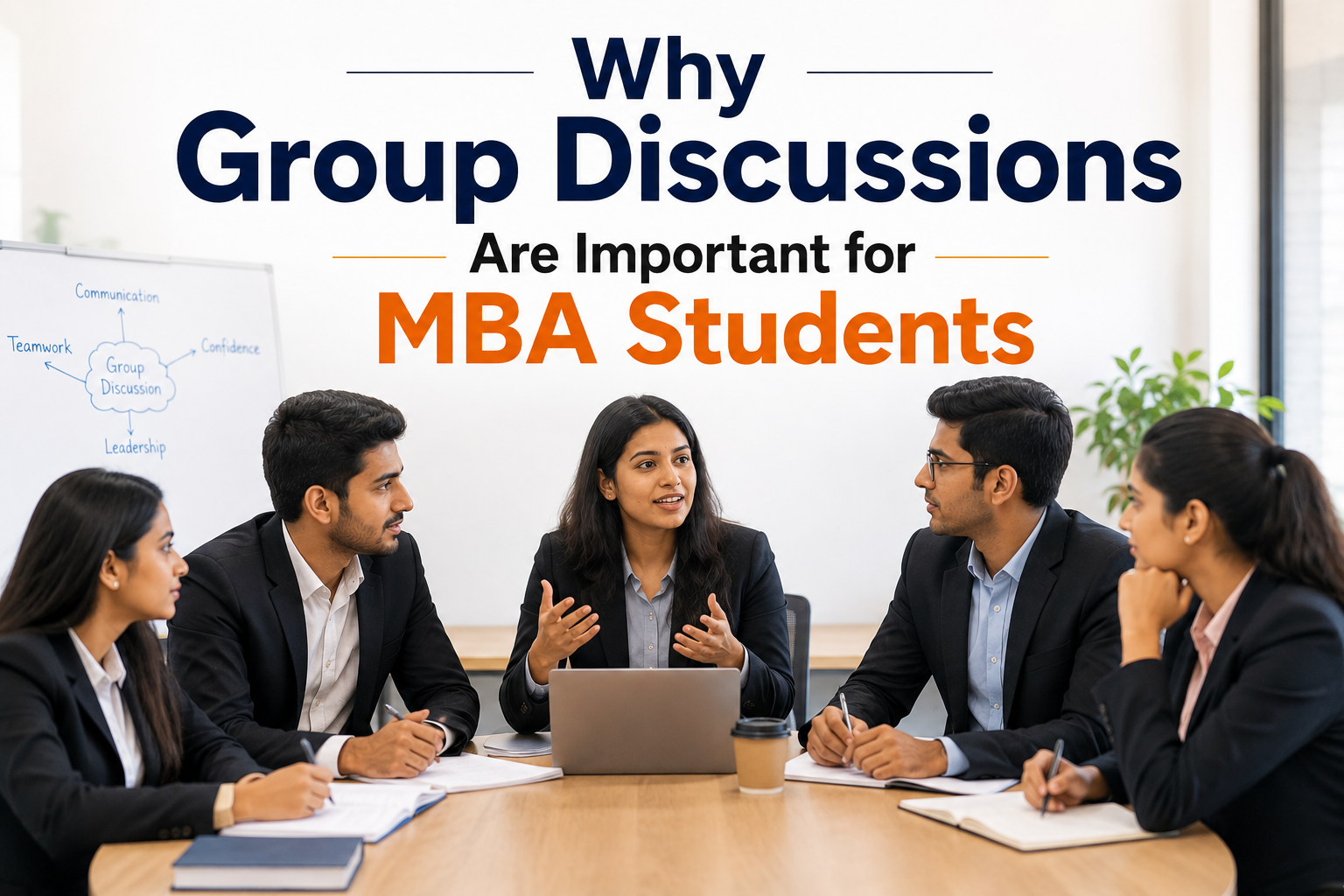
The corporate world is completely different from an MBA classroom. In the real-world manager has to deal with team and board members, they have to negotiate with clients and conduct discussions with people who may have different opinions. This is where group discussions play an important role. This activity brings confidence in MBA students to interact and negotiate with others.
MBA classrooms are not only about books and examinations. Students have to solve real world scenarios to become corporate ready.
Group discussions are important tools for b-schools to develop soft skills in MBA students. It helps in creating a structured conversation in which participants discuss a situation, topic or a problem to find out the best solution. Students have to present their points without arguing with other participants.
Management is all about communicating ideas, listening actively, thinking strategically, negotiating, and making decisions. Group discussions give MBA students an opportunity to learn and practice management processes.
According to GMAC's Corporate Recruiters Survey the most important skills developed in b-schools are problem-solving, strategic thinking, communication, adaptability and leadership.
In this blog we will deep dive into why group discussions are important for MBA students, why it is the recruiter's choice for the selection process, what students can do to be good at group discussions and how business schools use group discussion to train students to make them corporate ready.
Read More: Top 50 Business Schools in India Rankings & Placement wise 2026
Why are group discussions important for MBA students?
In a group discussion a successful student is the one who has complete knowledge of the topic, who understands it and owns it, additionally they have the skills to present it right on time, the one who has organized thoughts and actively listens to other participants and while presenting their point they don’t debate or argue instead responds appropriately with logic.
And this makes Group discussion further more important for MBA aspirants because this is the skill set they thrive for.
1. GD improves communication skills:
Communication is one of the most important traits of management professionals. A manager needs to communicate his ideas to the team and to other stakeholders in an understandable approach. Group discussions give students an opportunity to practice clear speaking, organize thoughts, presenting arguments, responding and negotiating to questions and making on time decisions.
Even students who initially fear to speak can learn from mistakes and become better every time.
Communication is one of those important skills that recruiters look for in MBA graduates.
2. Builds Leadership skills:
Leadership is not only to give instructions and lead others. A good leader with leadership skills guides, mentor, and solve problems for the team. Group discussions are the platform to develop leadership skills in the students.
· Leader can initiate the discussion round
· Guide and encourage other team members to participate
· Skills to manage the discussion if it is going off track or if there is a heated argument among members
· Professionally presents the crux of discussion
· Concludes the discussion
Leadership is the most found skill by recruiters when they are looking for managers.
Read More: Impact of Privatization on Indian Economy 2026
3. Builds Soft skills:
Technical and academic skills are important for students but if they lack soft skills, they will not be able to survive in the real world. Skills like teamwork, active listening, problem solving and decision making are not taught through any text books. They are built only by practice; group discussions are one of the best platforms to imbibe these skills in students.
According to the World Economic Forum's 2025 report 50% of employers look for empathy and active listening as the core skill in employees.
Cased base group discussions help students to analyze the problem, understanding pros, corns, impact of it, evaluating alternatives and reaching a conclusion with logical reasons. This builds decision making skills which is the most important activity of managers.
4. Builds emotional intelligence and confidence:
Going on stage and addressing the audience is not everyone’s cup of tea. As it requires skills, emotional intelligence and confidence.
No matter how much it is taught, it will only come by actually getting exposed to it.
For example, if someone strongly disagrees with your point and starts an argument, you will be required to approach it calmly with confidence and this approach requires emotional intelligence.
Group discussions help in building emotional intelligence, overcome hesitation and respond confidently in situations.
5. Prepare students for Placements and Corporate life:
Group discussions are the best form of simulation to help students understand real world scenarios. When students transit from college to corporate they need to attend meetings, client meetings, make strategic decisions and interact with senior management.
All these activities require enhanced communication, leadership and soft skills. A GD creates or replicates the situation where students can perform and learn all these activities before addressing it in real life.
Read More: List of Top 20 Tier 1 MBA College in India
Recruiters most used selection round
Group discussions are observed to be the most used round by recruiters for jobs specially among MBA students. Today’s business world is completely AI driven. Technical tasks are completely automated with the help of AI tools and in this scenario, recruiters look for human skills in employees. According to GMAC's 2026 research, human capabilities such as communication, adaptability and emotional intelligence are becoming harder to replicate through technology and therefore more valuable.
With the help of group discussion rounds it becomes convenient for recruiters to evaluate and shortlist candidates on the basis of Communication, Confidence, Leadership, Logical thinking, Listening, Team behavior, Problem-solving and Ability to handle pressure.
Hence, Group discussions become the most important round for selecting management students.
How students can become better at Group Discussions
Group discussion is not a born talent, it is a skill which can be developed from constant practice. Students can refer following points to outshine and becoming better in group discussions-
· Reading and updating knowledge regularly
· Practicing to speak clearly and confidently
· Active listening
· Structuring and organizing thoughts
· Practicing with friends or participating in mock GDs
· Overcoming disagreements with calmness
· Working on body language and voice modulations
It is to be remembered that group discussions are not debates where you have to prove your point, it is a discussion where you have to analyze the points and reach the solution.
Role of Business Schools to make GDs more effective
Group discussions are not merely the round of selection during placements and MBA admissions, it is much more valuable. It is an upgraded form of case study of the professional world.
It helps students to understand the real world, how to start and build conversations, how to interact with others, and most importantly to make them understand your point and concluding decisions.
These skills are core of management and give long term career success not just the first job. Business Schools and Management institutes should include group discussions in their curriculum and a regular practice for students
At Taxila Business School, group discussions are part of curriculum during MANCOM classes in which every student has to participate compulsorily in the guidance of their mentors who give them regular feedback and help them in becoming confident speakers.
Conclusion: Speak what matters
Group discussions are not only selection filters. It prepares you for your professional journey by making you ready to deal with people.
Being an MBA student, group discussions give you a platform to become a leader, a good communicator and ultimately an effective manager who knows how to manage a team and handle situations to provide valuable business decisions. It helps you to build skills which AI cannot replace.
Read More: